


Space Exploration: The New Space Race Isn't Just About Rockets — It’s About Building the Future

On a quiet morning somewhere along Florida’s Atlantic coast, a rocket stands upright on a launch pad.
It is about 70 meters tall—roughly the height of a 20-story building. Inside its fuel tanks are hundreds of tons of liquid oxygen and rocket-grade kerosene. Engineers in nearby control rooms watch telemetry streams scrolling across screens. Temperatures, pressure readings, navigation data.
Then the countdown reaches zero.
In seconds, nine engines ignite. Flames spread across the concrete pad and the rocket begins to rise, slowly at first, then faster, until it disappears into the sky at more than 17,000 miles per hour, fast enough to stay in orbit around Earth.
Moments like this still feel extraordinary. But what’s remarkable today is how often they happen.
Space is no longer a rare frontier visited only by governments. It has become an industry.
And it’s growing fast.

Space Is Becoming a Trillion-Dollar Industry
For most of the 20th century, space exploration was dominated by national agencies like NASA and the Soviet space program. Missions were expensive, infrequent, and usually tied to geopolitical competition.
Today, space looks very different.
The global space economy reached about $570 billion in 2023, and continued growing to roughly $613 billion in 2024, driven largely by commercial companies building satellites, launch vehicles, and space infrastructure.
Private companies now make up the majority of activity in orbit.
And they are launching things at a pace that would have seemed unimaginable just two decades ago.
In 2024 alone, more than 2,500 operational satellites were launched, contributing to a total of over 11,500 active satellites orbiting Earth today.
That number was only 3,371 satellites in 2020.
In other words, the amount of technology orbiting our planet has more than tripled in just a few years.

The Rockets That Made It Possible
None of this growth would be possible without a fundamental shift in rocket engineering.
For decades, rockets were disposable machines. After launch, the most expensive components—engines, guidance systems, structural hardware—fell into the ocean and were never used again.
Launching payloads to space could cost $20,000 per kilogram or more.
Then companies like SpaceX began experimenting with something radical: reusable rockets.
Their workhorse launch vehicle, the Falcon 9, can lift more than 22,000 kilograms of payload to low-
Earth orbit and then land its first stage vertically back on Earth.
Imagine throwing a pencil across a football field… and having it land upright on a small target.
That is roughly the level of precision required.
By reusing boosters multiple times, companies dramatically reduce launch costs and increase launch frequency. Rockets that once flew once can now fly 10, 15, or even more missions.
The result?
Space has become far more accessible.
Startups can now deploy satellites, universities can run orbital experiments, and new industries are forming around space-based data and infrastructure.
Satellites: The Technology You Use Every Day
Most people imagine astronauts when they think about space. But astronauts are actually a tiny part of the modern space economy.
The real workhorses of space are satellites.
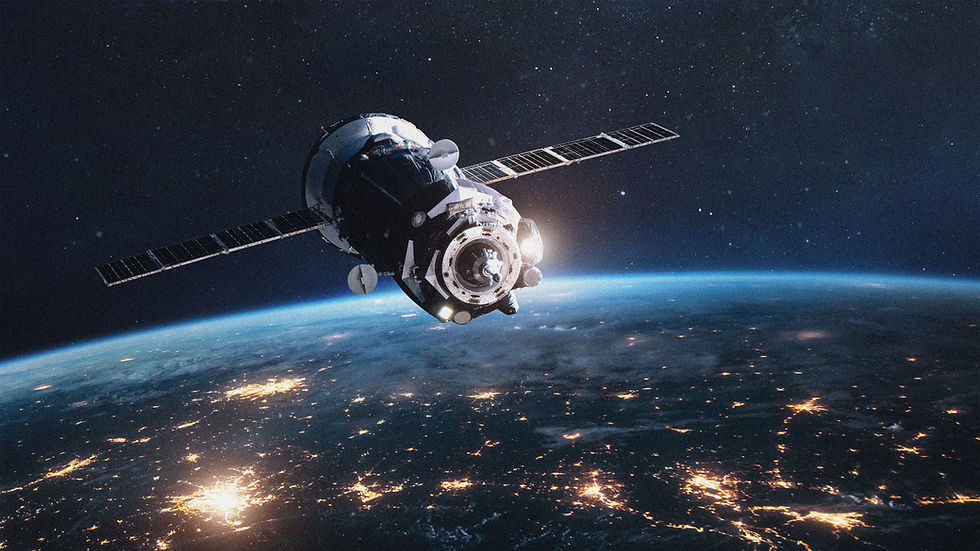
These machines orbit hundreds of kilometers above Earth, quietly powering services that billions of people rely on every day.
When you:
open Google Maps
check the weather
withdraw money from an ATM
track a package online
you are likely using satellite infrastructure somewhere in that process.
Satellites provide navigation signals, telecommunications, Earth observation imagery, and global timing systems that modern economies depend on.
One of the fastest-growing satellite networks is Starlink, which aims to provide high-speed internet across the globe.
The constellation already includes thousands of satellites in orbit, with long-term plans for tens of thousands more.
Each satellite is about the size of a coffee table, equipped with solar panels, propulsion systems, and advanced communication antennas.
Together, they form something remarkable: a global network in space.
That network can deliver internet to remote villages, ships in the ocean, and research stations in the Arctic.
Places where traditional infrastructure would cost billions of dollars to build.

Watching Earth From Space
Another fast-growing area of space technology is Earth observation.
Modern satellites can image our planet with astonishing detail.
Some capture images with resolution better than 30 centimeters, meaning they can see objects about the size of a backpack from orbit.
These images are not just used for maps.
They help scientists track:
deforestation in the Amazon
glacier melting in Antarctica
crop health across millions of acres of farmland
damage after natural disasters
Entire industries now depend on satellite data.
Insurance companies analyze satellite imagery after hurricanes. Farmers monitor soil moisture from space. Governments track environmental changes across entire continents.
In many ways, satellites have become the planet’s nervous system—constantly sensing, measuring, and transmitting information about the world below.

The Moon Is Back on the Agenda
For more than 50 years, humans have not returned to the Moon.
But that is about to change.
Through the Artemis Program, NASA and international partners are preparing to land astronauts near the lunar south pole later this decade.
The region is especially interesting because scientists believe large deposits of frozen water may exist inside permanently shadowed craters.
Water in space is incredibly valuable.
It can support human life, but it can also be split into hydrogen and oxygen—two key ingredients for rocket fuel.
If future missions can extract and use lunar water, the Moon could become a refueling station for deeper space exploration.
That could dramatically change how humanity explores the solar system.
But Space Is Getting Crowded
With thousands of satellites launching every year, Earth’s orbit is becoming increasingly busy.
And that raises new challenges.
Space debris—broken satellites, fragments from collisions, and discarded rocket parts—can travel at speeds above 28,000 kilometers per hour.
Even a piece of metal the size of a marble can damage a spacecraft at those velocities.
Scientists have long warned about a scenario called Kessler Syndrome, where collisions create cascading debris that triggers further collisions.
Managing orbital traffic is now becoming a major global challenge.
Companies and governments are investing in space traffic monitoring, autonomous collision avoidance systems, and debris removal technologies to keep orbital space safe and usable.
Space is no longer empty.
It is infrastructure.

Why Space Needs Storytelling
For engineers and scientists working in the industry, concepts like orbital mechanics or phased-array antennas are everyday tools.
But for most people, space technology can feel abstract or difficult to understand.
That’s why storytelling matters.
Space exploration isn’t just about rockets or satellites. It’s about how those technologies affect life on Earth.
It’s about explaining why:
satellite data helps farmers feed millions
space-based communications connect remote communities
new propulsion systems could unlock exploration beyond Earth
The future of space will not be built only by engineers.
It will also be shaped by how well we communicate the ideas behind the technology—to policymakers, investors, and the public.
Because when people understand what space technology can do, they are far more likely to support the innovations that push humanity forward.
The Next Giant Leap
Sixty years ago, the Apollo 11 Moon Landing showed the world what was possible when engineering, ambition, and storytelling came together.
Today we are entering a new phase of that journey.
Thousands of satellites are building digital infrastructure in orbit. Reusable rockets are lowering the cost of access to space. Scientists are preparing missions that could one day send humans to Mars.
The scale of change is enormous.
And we are still at the beginning.
The next chapter of space exploration won’t just be written in launch logs and engineering diagrams.
It will be written in the stories we tell about why these technologies matter—and how they shape the future of humanity, both on Earth and beyond it.


Comments