


Six Women, Eleven Minutes, and One Powerful View of Earth
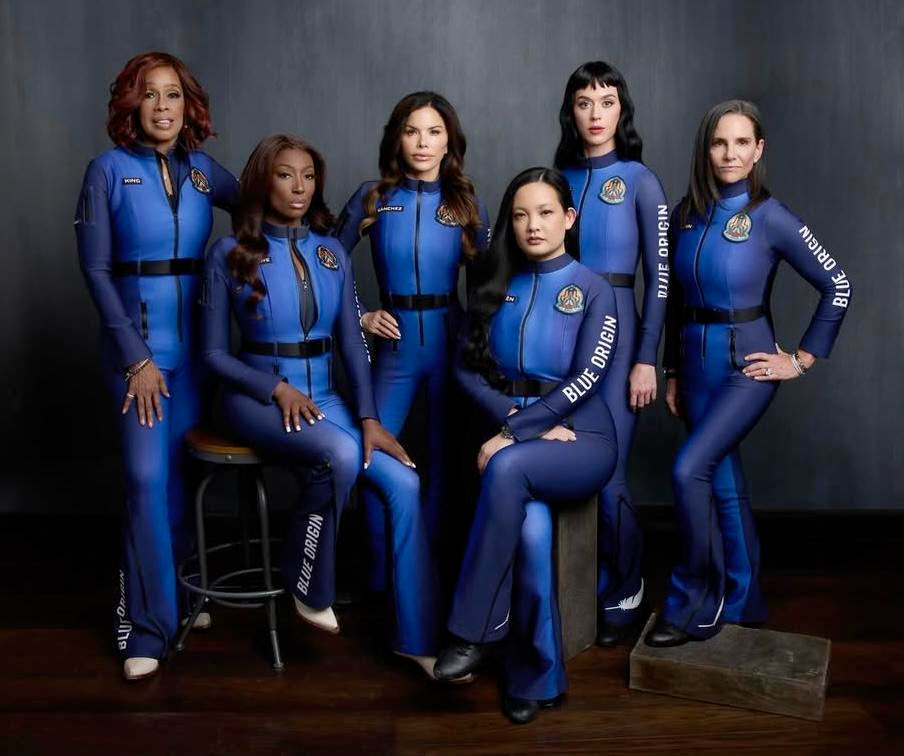
The Story Behind the Historic All-Female Spaceflight...
On the morning of April 14, 2025, a rocket stood quietly in the Texas desert.
The vehicle, called New Shepard, is designed for short trips to the edge of space. It isn’t built to orbit the Earth or travel to the Moon. Instead, it does something equally powerful: it allows people to experience space for the first time—seeing the planet from above and floating in zero gravity.
At 9:30 a.m., the rocket launched from West Texas carrying six women on a historic mission known as Blue Origin NS-31. For about 11 minutes, they traveled more than 62 miles (100 km) above Earth, crossing the Kármán line, the internationally recognized boundary of space.
It was a short journey, but symbolically, it was a big one.
For the first time in decades, a spacecraft carried an all-female crew, representing fields from aerospace engineering to journalism, science, activism, film, and music.
And for a few brief minutes, six women looked down at Earth from space.

The Rocket That Made It Possible
The mission was operated by Blue Origin, the private space company founded by Jeff Bezos.
The company’s New Shepard rocket is part of a growing space tourism industry. Unlike traditional orbital spacecraft, New Shepard flies on a suborbital trajectory—a steep arc that reaches space but does not circle the planet.
Here’s how the flight works:
The rocket launches vertically from the desert.
The capsule separates from the booster about 2–3 minutes into flight.
The crew experiences several minutes of weightlessness.
The capsule returns to Earth using parachutes while the booster lands vertically on its own.
The entire mission lasts roughly 10–11 minutes.
But during those minutes, passengers see something astronauts often describe as life-changing: Earth suspended in the darkness of space.

Meet the Six Women Who Went to Space
The crew of the NS-31 mission included women from very different professional backgrounds.
Lauren Sánchez
Journalist, helicopter pilot, and vice chair of the Bezos Earth Fund, Lauren Sánchez organized the mission and helped assemble the crew. She described the experience of seeing Earth from space as “profound,” emphasizing how fragile the planet looks from above.
Aisha Bowe
Former NASA rocket scientist, entrepreneur, and STEM advocate Aisha Bowe represented the engineering side of the mission. Bowe has spent years working to expand opportunities for women and minorities in aerospace. For her, the flight was about showing young people that scientists can come from anywhere.
Amanda Nguyen
Civil rights activist and bioastronautics researcher Amanda Nguyen also joined the crew. Nguyen is known for advocating for survivors of sexual assault and later pursued research connected to space medicine. Her presence symbolized the intersection of science, policy, and human rights.
Gayle King
Veteran journalist and television host Gayle King admitted before the launch that she was nervous about flying. After returning to Earth, she joked that the experience required courage—doing something that scares you but doing it anyway.
Kerianne Flynn
Film producer Kerianne Flynn represented the storytelling world. Her career focuses on producing films that highlight social issues and human resilience.
In many ways, her role on the flight symbolized something important: space exploration is not just about engineers—it’s also about the stories we tell about exploration.
Katy Perry
Finally, the mission included pop music superstar Katy Perry.
Perry brought a small daisy into space to honor her daughter and later said the experience made her feel deeply connected to humanity. During the flight, she even sang “What a Wonderful World.”

What the Crew Experienced in Space
After launch, the rocket accelerated to speeds of over 2,000 miles per hour.
A few minutes later, the capsule separated and drifted quietly through space.
Inside, gravity disappeared.
Pens floated in midair. Hair lifted. The crew members gently pushed themselves off the walls of the capsule, experiencing microgravity—the same sensation astronauts feel on the International Space Station.
Outside the windows, the view was extraordinary.
The sky was no longer blue. It was pitch black.
Below them, Earth appeared as a glowing curve with thin blue atmosphere hugging the planet.
This perspective is often called the “Overview Effect.”
Astronauts frequently describe it as a moment that changes how they see the world.
Borders disappear. The planet looks small and fragile.
And for a moment, everything feels connected.
Why This Mission Was Significant
Although the flight lasted only minutes, it captured global attention.
The mission was widely described as the first all-female crewed spaceflight since 1963, when Soviet cosmonaut Valentina Tereshkova became the first woman to travel to space.
That historical gap highlights an uncomfortable truth about the aerospace industry.
For decades, space exploration has been dominated by male astronauts, engineers, and leadership teams.
Women have made enormous contributions to space science—from mathematicians at NASA to engineers designing spacecraft—but their stories have often received less attention.
This mission helped shift that narrative.
Even though the passengers were not career astronauts, the visibility of six women traveling to space together sent a powerful message about who belongs in the future of exploration.

A Mission That Sparked Conversation
The flight also sparked debate.
Some critics argued that the mission was largely a celebrity-driven publicity event tied to the growing space tourism industry. Others questioned whether short suborbital flights meaningfully advance science.
Supporters, however, emphasized the importance of visibility and inspiration.
Seeing a former NASA engineer, a scientist, a journalist, a filmmaker, an activist, and a global music icon all sharing the same spacecraft illustrates something new about the space age.
Space is no longer reserved only for professional astronauts.
It is gradually becoming a place where many kinds of people can participate.
The Bigger Picture: The Democratization of Space
The mission reflects a broader transformation happening in the space industry.
For most of history, only government astronauts traveled to space.
Now private companies—including Blue Origin, SpaceX, and others—are working to make spaceflight more accessible.
The long-term vision is ambitious:
Scientists conducting experiments in microgravity
Artists and filmmakers documenting space
Researchers studying human health in space environments
Eventually, even tourists experiencing space for themselves
Each mission like NS-31 helps push that future a little closer.

Eleven Minutes That Symbolized Something Bigger
The capsule touched down softly in the Texas desert after just 11 minutes in flight.
It was over almost as quickly as it began.
But for the six women aboard—and for millions watching around the world—the journey represented something bigger than a brief trip beyond Earth’s atmosphere.
It showed that the story of space exploration is expanding.
Not just in technology, but in who gets to participate in the adventure.
And as space becomes more accessible, the next generation of explorers may come from anywhere—scientists, storytellers, engineers, activists, or dreamers who once looked up at the night sky and wondered what it would feel like to see Earth from above.
For these six women, that question was answered.
And for 11 minutes, they saw our planet the way only a handful of humans ever have—from space.


Comments